

Here is a number worth remembering for your next science lesson: 274. That is how many moons Saturn is now officially known to have, after astronomers confirmed 128 new ones in a single announcement. No other planet comes close. Jupiter, Saturn’s great rival, has 95, which means the ringed planet now has more moons than all the other planets in the solar system put together.
If you are picturing 274 glowing spheres like our own Moon, think smaller. Nearly all of the newcomers are irregular moons: lumpy chunks of rock and ice, some barely three kilometres wide, orbiting millions of kilometres from Saturn. Many travel backwards compared with the planet’s spin, a clue that they were not born beside Saturn at all, but were captured or left behind when bigger moons smashed into each other.
A telescope, a mountain and a clever trick
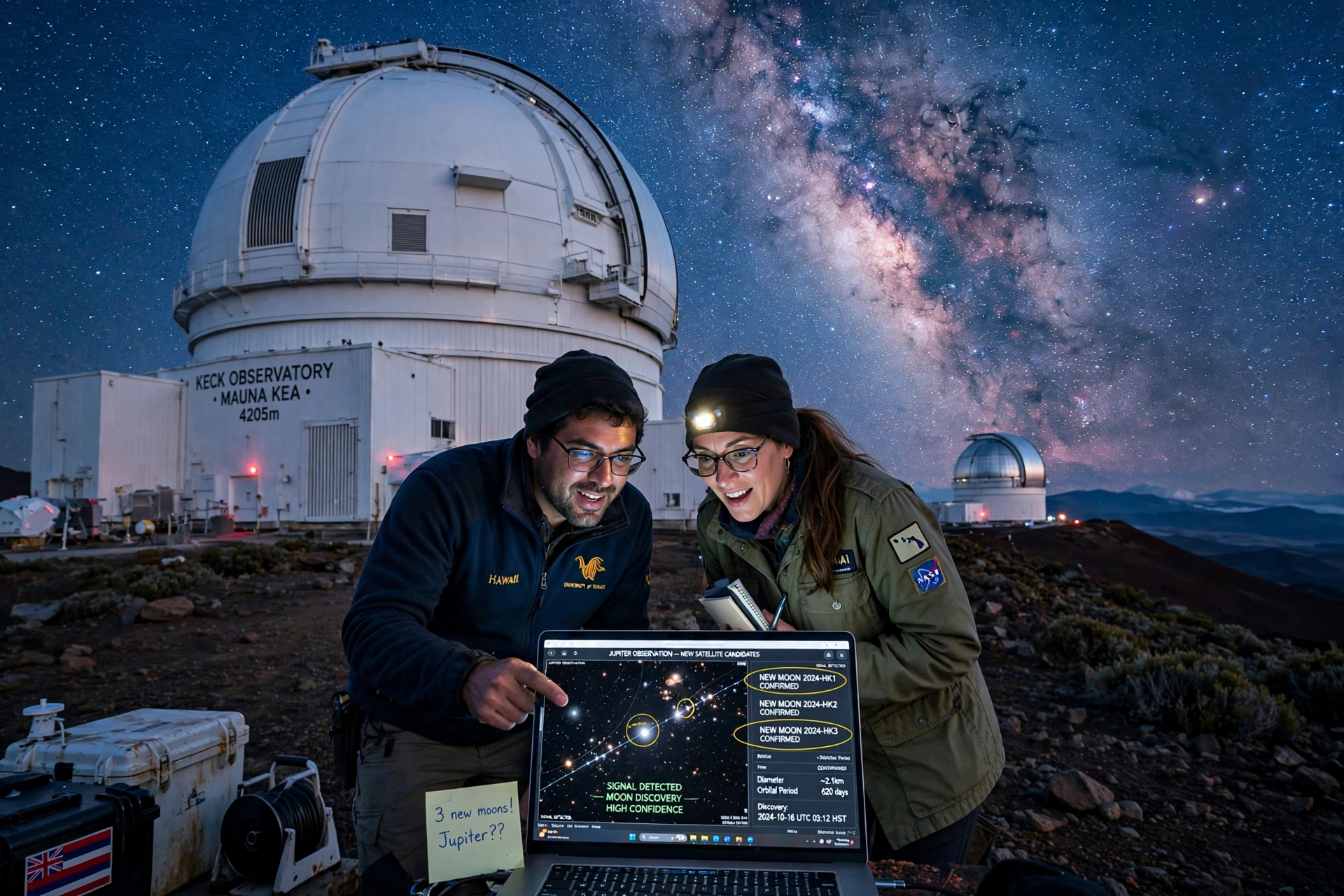
The moons were spotted using the Canada-France-Hawaii Telescope, high on Mauna Kea in Hawaii, by a team that includes researchers from the University of British Columbia. Finding objects this faint takes a trick called shift-and-stack: astronomers take many long photographs, shift each one slightly to follow a possible moon’s motion, then stack them together. A moon too faint to see in one picture slowly appears in the combined image.
Nothing is official until the International Astronomical Union checks the orbits, sometimes over several years of follow-up observations. Students curious about how professional astronomy teams organise this kind of work can explore the research pages of the University of British Columbia. Our earlier classroom-friendly report on the SpaceX launch that lit up the East Coast sky shows the same patience at work in a very different setting.
Why scientists care about tiny moons
Tiny moons are like crumbs at a picnic: they tell you what happened earlier. Because the new moons cluster into families with similar orbits, astronomers think each family is the debris of one larger moon that broke apart in a collision. Dating those break-ups helps scientists rebuild the history of the outer solar system, including how often big impacts still happen.
The discovery also raises a brilliant discussion question. At what point does a pebble stop being a moon? At present, any rock in a confirmed orbit counts, whatever its size. As telescopes improve, Saturn’s tally could rise into the thousands, and scientists may need to agree a minimum size. It is a reminder that even simple words like moon hide real scientific arguments.
Questions to take into class
Try these: why do captured moons often orbit backwards? Why does stacking photographs reveal fainter objects than a single long exposure? And if you could name one of the 128 new moons, what would you choose, and why? The naming rules are strict, drawing on mythology linked to each moon’s family, but the thinking behind a good name is a fine exercise in itself.
Try this at home
You cannot see the new moons with a school telescope, because they are far too faint, but you can see Saturn itself on a clear night, and through even a modest telescope its rings are unmistakable. Look for a steady, pale gold light that does not twinkle as much as the stars around it. Titan, Saturn’s largest moon, may appear as a tiny point nearby. Everything else in the family of 274 is far beyond amateur instruments, which is rather the point: the visible Saturn is the tip of an enormous, mostly hidden system.
Teachers might also use the announcement to discuss how science updates itself. The figure of 274 is not a guess or a vote; it rests on published orbits that any observatory can test. If a future team shows that one of the moons is actually two objects, or that an orbit was misread, the number will change again, openly and on the record. That willingness to revise is not a weakness in science. It is the whole method, working exactly as it should, in public.
One thing is certain: the solar system you learn about this year is not quite the one in last year’s textbook. Saturn’s crown of moons just grew by 128, and the astronomers who found them suspect there are plenty more still hiding in the dark.
