

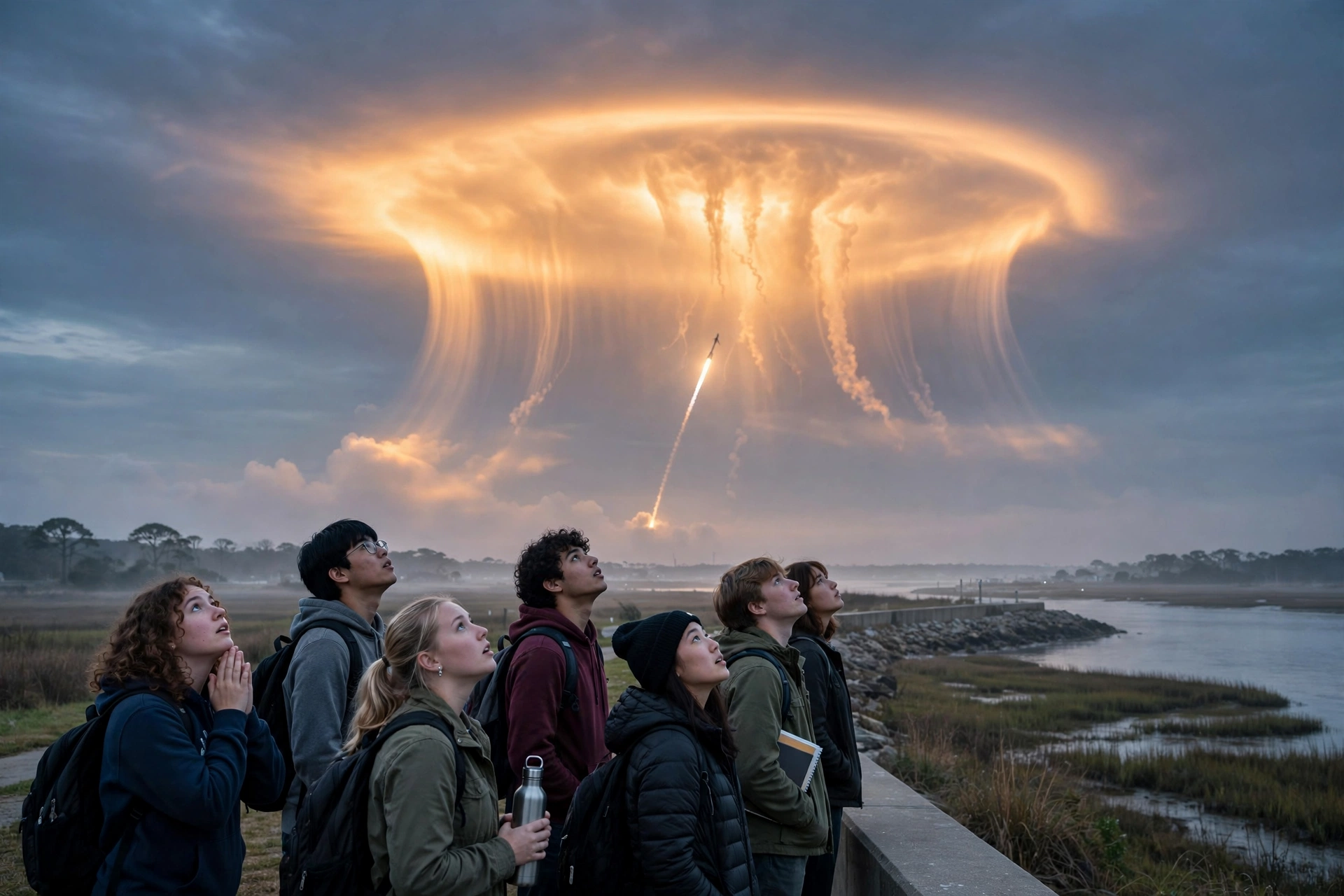
Early risers along the United States East Coast were treated to a strange and beautiful sight this week when a SpaceX rocket launch created a glowing, jellyfish-shaped cloud high in the morning sky. Photos shared from beaches, backyards and school run routes showed a bright plume spreading out like the bell and tentacles of a jellyfish, lit up against a still-dark sky. It looked mysterious, but the science behind it is simple enough to explain in any classroom — and it is a perfect example of how everyday physics can turn a routine launch into a natural light show.
What People Saw in the Sky
The phenomenon appeared shortly after lift-off, as the rocket climbed through the upper layers of the atmosphere. On the ground, the sky was still in twilight, but high above the surface the rocket’s exhaust plume had already caught the sunlight. The result was a luminous cloud that expanded and twisted as the upper winds caught it, forming the rounded top and trailing streamers that give the effect its jellyfish nickname. Reports and images of the display were widely shared, and coverage of the launch and the cloud it created noted how far the spectacle could be seen along the coast.
Events like this are sometimes called “space jellyfish,” and they tend to happen with launches that take place just before sunrise or just after sunset. That timing is everything. A launch in the middle of the day produces a plume that is barely noticeable, and a launch in the middle of the night stays dark. It is only in that narrow twilight window that the contrast appears: darkness at ground level, and full sunshine tens of kilometres above it.
The Simple Science Behind the Jellyfish Effect
Three ingredients create the effect. The first is height. A rocket exhaust plume expands dramatically in the thin air of the upper atmosphere because there is very little air pressure pushing back on it, so the gases spread into a wide, rounded bulb instead of the tight stream seen at sea level. The second ingredient is sunlight. At dawn, the Sun is below the horizon for people on the ground, but its rays still reach the upper atmosphere, illuminating the plume like a spotlight hitting smoke in a dark room.
The third ingredient is wind. High-altitude winds blow in different directions and at different speeds at different heights, so the glowing plume is stretched, curled and separated into trailing strands. That is what creates the tentacle-like streamers beneath the bright bell of the cloud. Students who enjoy science stories like this may also like our earlier discussion of how much technology is too much for young children, which shows how the same curiosity can be applied to everyday questions at home.
Why These Launches Keep Trending Online
Part of the reason the images spread so quickly is that the jellyfish cloud does not look like anything else in the sky. It does not resemble a plane trail, a shooting star or a weather cloud, so people who see it for the first time often assume they are watching something extraordinary. In a sense they are: the sight depends on the precise angle of the Sun, the altitude of the rocket and the state of the upper atmosphere all lining up at once.
Launches from Florida’s Space Coast are especially well placed to produce the effect for East Coast viewers, because the rockets head out over the Atlantic and climb into the dawn light. As launch schedules become busier, with commercial, scientific and government missions sharing the calendar, sky watchers are getting more chances to witness the phenomenon — and each new set of photographs introduces it to a fresh audience.
A Teachable Moment for Students
For teachers and parents, a trending sky event like this is a ready-made lesson. It connects spaceflight to atmospheric physics, light and perspective in a way that a textbook diagram rarely manages. A simple question — why is the cloud glowing when the ground is still dark? — opens the door to discussions about the curvature of the Earth, the height of the atmosphere and why satellites and the International Space Station can also shine brightly at dawn and dusk.
It is also a useful reminder about checking sources before sharing dramatic images. Unusual sky pictures attract exaggerated claims quickly, so it helps to compare photographs with launch schedules and trusted reporting first. The same habit protects readers in their everyday feeds, a theme we explored in our guide to managing notifications and privacy on the apps students use most.
How to Catch the Next One
Anyone hoping to see a jellyfish cloud should watch for launches scheduled in the hour before sunrise or just after sunset, then simply look towards the launch site’s direction a few minutes after lift-off — no telescope is needed, because the plume can be enormous. Clear skies matter more than equipment. If the conditions line up, the cloud will appear to bloom silently overhead, glow for several minutes, and slowly fade as the sunlight geometry changes. It is one of the rare moments when a routine piece of space engineering turns into public art, free for everyone awake early enough to see it.
