

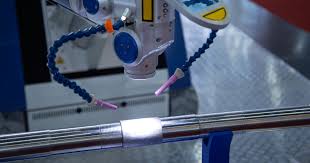
The tools have dictated the manufacturing possibilities. From hand forging to arc welding to computer-controlled machining, each technological advance has expanded what is possible in precision, speed, and material. Laser welding is just the latest in this progression – a method that is quickly replacing traditional techniques across industries where accuracy and predictability are a given.
What Is Laser Welding Technology?
Laser welding has the application of a very focused beam of light energy to the joint interface for heating the materials to be welded. The laser produces high-intensity heat at a very small focal point, allowing the base materials to be melted together without expandable heat affected zone, as seen in traditional welding processes. A slight focal point offsetting and the result is a deep, narrow weld bead with very little distortion for the surrounding material. Today’s systems are computer-controlled and can follow intricate joint geometries at speeds that are impossible to attain with manual or semi-automatic methods.
How It Differs from Traditional Welding Methods
Traditional arc welding, MIG, and TIG welding heat is applied over a fairly broad track width. This thermal spreading leads to distortion, residual stresses, and a heat-affected zone (HAZ) which results in loss of material properties near the weld. Grinding, straightening, or stress-relieving treatment after the weld adds time and cost to the manufacturing process.
Laser welding energy is so focused that the size of the heat-affected zone can be a fraction of that with conventional techniques. Thin-gauge metals that would have warped or burnt through with arc welding are joined with confidence. Moreover, since laser systems do not contact the work, there is no electrode wear or risk of contamination, as with traditional methods.
Key Benefits of Precision Laser Welding
Reduced Material Waste
Minimal filler material is needed since the laser systems produce a small weld bead. Narrow joint tolerances result in less pre-weld preparation and fewer post-weld reworks. In applications for high-value materials, titanium aerospace components, stainless medical housings, or copper electrical connectors — this reduction in waste directly reduces the per-unit cost of production.
Faster Production Cycles
The speed of laser welding is much faster than manual TIG- or MIG-based processes. Laser in the form of automation can also, in turn, weld in a continuous fashion along programmed paths without operator fatigue, reposition delays, or variations between operators. For line production, for example, in a high-volume production environment, this means significantly reduced cycle times and increased output per shift.
Consistent, Repeatable Quality
Variability in human operators is one of the most enduring quality problems in traditional welding. Lasers run to programmed parameters exactly, producing the same weld profile on thousands of parts with no loss of quality — an important requirement in regulated industries.
Industry Applications
Aerospace: Turbine blades, fuel system parts, and structural airframe assemblies require welds that conform to rigorous fatigue and pressure standards. Laser welding is capable of forming the deep-penetration, low-distortion joints needed for these parts.
Automotive: Body panel joining, battery pack assembly for electric vehicles, and transmission parts capitalize on the speed and accuracy laser systems deliver at high-volume production rates.
Electronics: Miniaturized circuit housings, sensor enclosures and connector assemblies are made from materials and with tolerances that render laser welding the only feasible joining solution at scale.
Medical devices: Surgical tools, implantable device shells and diagnostic equipment demand clean, contamination-free welds in biocompatible materials — which is a perfect fit for the laser process’ controlled environment.
A well-established laser welding machine supplier that is well-established keeps you up to date with systems that are developed as per these stringent application conditions and contain process controls and certifications that the relevant industries demand.
Selecting the Right Manufacturing Partner
System selection goes beyond laser power specifications. Beam quality, motion system precision, software integration capability, and after-sales technical support all determine whether a laser welding investment delivers its expected return. An experienced laser welding machine manufacturer will assess the specific material types, joint configurations, and production volumes involved before recommending a system configuration rather than offering a one-size-fits-all solution.
Conclusion
Laser welding is no longer the preserve of specialist applications, but has become a standard technique in precision engineering. The synergistic combination of high speed, high accuracy, good material utilization and good process stability meets well the core needs of modern production environments not only for aerospace, automotive, electronics and medical but in general. With system prices falling and levels of automation increasing, laser welding is set to become the default joining process for any manufacturer who wants to be taken seriously when it comes to quality and efficiency.