

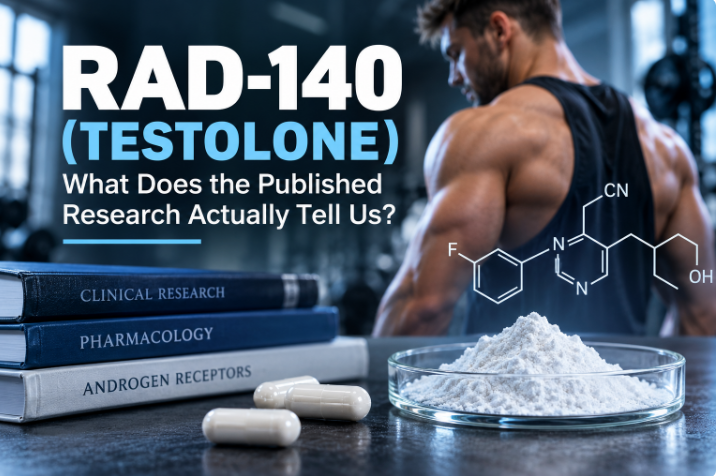
RAD-140, also commonly known as Testolone, is a non-steroidal selective androgen receptor modulator (SARM) that has attracted considerable research interest.
Unlike traditional anabolic-androgenic steroids, SARMs were developed to investigate whether androgen-receptor activity could be targeted more selectively in different tissues.
RAD-140 remains an investigational compound, however, and understanding the difference between laboratory findings, animal studies and human clinical evidence is particularly important when discussing its research.
What Is RAD-140?
RAD-140 is an orally bioavailable, non-steroidal selective androgen receptor modulator.
Early published research characterised the compound and investigated its activity in preclinical models of androgen action.
Researchers found that RAD-140 demonstrated potent androgen-receptor activity while exhibiting tissue-selective characteristics, which contributed to subsequent scientific interest in the compound.
Readers interested in the compound itself and its research background can find further information on RAD-140 from Affordable Nutrition.
Why Are Selective Androgen Receptor Modulators Studied?
The androgen receptor plays an important role in numerous biological processes.
Traditional androgenic compounds can influence receptors across multiple tissues, which has encouraged researchers to investigate compounds capable of producing more selective androgen-receptor activity.
SARMs were therefore developed as an area of pharmaceutical research rather than simply as alternatives to traditional anabolic compounds.
Different SARMs possess different chemical structures and pharmacological characteristics, meaning findings involving one compound should not automatically be applied to another.
What Does Preclinical RAD-140 Research Show?
Some of the earliest published RAD-140 research investigated the compound in preclinical models.
A 2014 paper describing its design and preclinical characterisation identified RAD-140 as a potent, orally bioavailable, non-steroidal SARM.
Subsequent laboratory research also investigated RAD-140’s interaction with the androgen receptor in androgen-receptor and oestrogen-receptor-positive breast cancer models.
These studies helped establish RAD-140’s biological activity, but preclinical findings should not be interpreted as demonstrating particular outcomes in healthy humans.
Has RAD-140 Been Studied in Humans?
Yes, although the available human research is considerably more limited than online discussion of RAD-140 sometimes suggests.
A first-in-human Phase I study investigated RAD-140 in postmenopausal women with advanced or metastatic ER-positive/HER2-negative breast cancer.
The study evaluated areas including safety, tolerability, pharmacokinetics and androgen-receptor engagement.
Researchers reported evidence of androgen-receptor engagement, while also recording treatment-emergent adverse events including elevations in liver enzymes.
This is important context: the study population consisted of patients with advanced cancer and was not designed to establish bodybuilding, strength or athletic-performance effects in healthy individuals.
RAD-140 and the Androgen Receptor
Much of the scientific interest surrounding RAD-140 comes from its interaction with the androgen receptor.
Preclinical research has demonstrated high-affinity androgen-receptor binding and tissue-selective activity.
This provides a biological basis for continued scientific investigation, but it doesn’t mean that every effect commonly attributed to RAD-140 online has been established in controlled human research.
Distinguishing established evidence from extrapolation is particularly important with investigational compounds.
Understanding RAD-140 Research
Another consideration when examining RAD-140 is how researchers design protocols around the pharmacological characteristics of the compound.
Factors such as pharmacokinetics, consistency and timing can all be relevant when interpreting research protocols and understanding why studies are structured in particular ways.
Those exploring the existing literature may also find this overview of RAD-140 research useful, particularly when considering how pharmacokinetics and consistency relate to research protocols.
Understanding the Limitations of RAD-140 Research
RAD-140 provides a useful example of why research compounds should be assessed according to the quality and type of evidence available.
There is published preclinical research and some human clinical data, but the human evidence base remains limited.
Claims concerning areas that have not been properly evaluated in controlled human trials shouldn’t be presented as established scientific fact.
For anyone researching RAD-140, the most useful approach is therefore to examine the original studies, understand what populations were investigated and distinguish between preclinical observations and demonstrated human outcomes.
Further research will ultimately determine considerably more about the compound’s pharmacology, safety and potential applications.
This article is provided for general educational and research information only and should not be interpreted as medical advice.
