

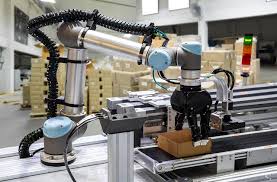
The manufacturing floors of today bear little resemblance to those of two decades ago. Robotic systems now perform jobs that were previously thought to require too much precision, too much repetition, or be too hazardous for human workers. At the core of any robotic system, there is a part that enables fluid, intelligent motion: the robotic joint. The way these parts work, in turn, helps explain why industrial automation keeps moving so incredibly fast.
What Are Robot Arm Joints?
A robot arm joint is the joint connecting two rigid segments of a robot arm, and it works in a similar way as the joint in the human skeleton. These parts enable the arm to rotate, bend, stretch, and pivot over several axes. Each joint is actuated with electrical motors, and these motors are equipped with precision encoders that convert the signals from the electrical domain into the physical one in a controlled fashion. In unison, multiple joints form a kinematic chain, and such a chain can reach almost any position within its workspace.
Types of Robotic Joints and Their Functions
Industrial robots experience a number of different joint configurations in various combinations to fulfill particular movement requirements:
Revolute joints rotate about a single axis, like a door hinge. They are the most prevalent joint type in industrial arms and provide the breadth of angular movement necessary for welding, painting, and assembly.
Prismatic joints travel linearly along a single axis and can be extended and retracted linearly. These find high application in pick-and-place applications and CNC machine loading.
Spherical (ball-and-socket) joints rotate about multiple axes at the same time and provide the largest amount of motion and thus best emulate shoulder-like motion in human arms.
Rotational and linear motions are combined in the cylindrical joint. These are particularly useful in pick-and-place applications as well as CNC machine loading.
The combination of these joint types defines a robot’s degrees of freedom (DOF) – greater DOF means the robot can handle more complex environments.
How Joints Enable Precision and Productivity
Accuracy is critical, and there is no compromise in industrial automation. A high-quality robot arm joint uses high-resolution encoders to enable real-time position feedback so the control system can perform small micro-movements while the system is in motion. This closed-loop control yields repeatability on the order of a kinematical half a millimeter – a degree of constancy that no human operator can maintain for long production runs.
Joints affect throughput as well as precision. Joint-optimized robots can run day and night without getting tired at the speed of the production line. Shorter cycle times, fewer mistakes, and practically zero downtime add up to lower costs per unit of production and higher doses.
Industry Applications
Automotive: Spot welding, painting, and component assembly on vehicle production lines is handled by multi-axis robotic arms. Their joints also allow them to access tight cavities and deliver consistent force over thousands of operations per shift.
Electronics manufacturing: Circuit board assembly and semiconductor handling require precision on the sub-millimeter scale. Refined joints in lightweight robotic arms allow for soldering and inserting components at speeds and with accuracy levels that a human could not achieve.
Logistics and warehousing: Sorting, palletizing, and order picking equipment use fast-cycling joints to adapt to a wide range of product shapes and weights in dynamic conveyor-based environments.
General manufacturing: Whether it’s food processing or aerospace manufacture, robotic joints provide for flexible automation that can be reprogrammed for new product lines without replacing the physical plant.
Future Trends in Robotic Joint Technology
The next generation of robotic joints is converging with AI and new materials science. Compliant joints with integrated force-torque sensors allow collaborative robots (cobots) to work safely with human operators by sensing unexpected contact and reacting immediately. Shape-memory alloys and materials for soft actuators are investigated for the realization of joints able to absorb shocks and to conform to uneven surfaces. Meanwhile, digital twin technology enables engineers to simulate joint wear and performance degradation before it impacts production, making predictive maintenance viable at scale.
Conclusion
Robotic joints aren’t just machinery parts they are the technology that enables every precise, repeatable, and efficient movement a robot makes. As joint technology evolves, the deadlock between robotic capabilities and production environment requirements will be broken, leading to even greater gains in industrial efficiency and product quality in every major manufacturing area.