

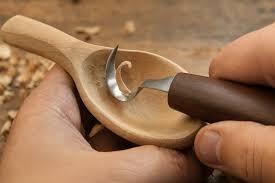
Pick up almost any well-made wooden spoon and run a finger along the inside of the bowl. That smooth, evenly curved hollow was almost certainly shaped with a hook knife https://woodcarving-tools.com/collections/hook-knives, a tool that looks unusual to anyone new to carving but becomes indispensable within the first few projects. If a straight knife is the workhorse of shaping the outside of a spoon, the hook knife is what makes the inside actually usable.
How a Hook Knife Works
The design is simple in concept: a curved blade, bent into a hook or crescent shape, that lets the edge scoop wood away in a controlled arc rather than a straight line. Where a straight blade would need to be tilted and angled awkwardly to remove material from a concave surface, and would still leave flat facets rather than a smooth curve, a hook knife follows the shape of the hollow naturally. This is why the tool is sometimes called a spoon knife, since hollowing a spoon bowl is its most common job, though it works equally well on small bowls, cups, and kuksas.
Choosing Curvature and Size
Curvature and size vary across the category, and matching them to the project makes a real difference.
- Tight, small-radius: delicate work like teaspoons, narrow serving spoons, or figurine details
- Wide, open curve: moves more wood per stroke, better suited to ladles, larger serving spoons, or the initial rough-out of a kuksa
Many carvers keep at least two hook knives on hand, one tight and one open, rather than trying to force a single knife to do both jobs.
Single-Bevel vs Double-Bevel
Bevel style is worth understanding before buying.
- Single-bevel: ground on one side only, cuts more aggressively, favored for shaping and rough hollowing
- Double-bevel (symmetrical): easier to control in either direction, better for smoother finishing passes
Left and right-handed versions exist as well, and while a skilled carver can often adapt, a knife matched to your dominant hand will feel noticeably more natural, especially when cutting toward the far side of a bowl.
Safe, Controlled Handling
Using a hook knife safely takes more attention than a straight blade, because the cutting motion typically pulls the edge toward the carver’s hand or body rather than away from it. Most experienced carvers use a controlled pulling or scooping motion with the workpiece braced firmly, often against the chest or in the lap with a carving glove or leather palm guard in place. Short, deliberate strokes are safer and more controllable than long sweeping cuts, and this is doubly true with a freshly sharpened hook knife, which will remove wood far more easily than expected on a first pass.
Keeping the Curved Edge Sharp
Sharpening a curved edge intimidates a lot of beginners, but the principle is the same as any blade: maintain a consistent bevel angle and strop regularly rather than waiting until the edge is visibly dull. Curved leather strops or a rounded slip stone loaded with honing compound make it far easier to follow the blade’s arc than a flat stone will. A hook knife that has lost its edge doesn’t just cut poorly, it tends to skip and catch unpredictably in a hollow, which is a more common cause of injury than the tool’s unusual shape would suggest.
Buying Your First Hook Knife
For anyone shopping for their first hook knife, buying from a maker that forges and pre-sharpens the tool saves a difficult early step, since getting a curved edge properly sharp from scratch is not a beginner task. STRYI’s hook knife range, available at https://woodcarving-tools.com/collections/hook-knives, covers single and double-bevel designs along with left-handed options, arriving ready to carve rather than requiring setup work first.
Once the motion clicks, hollowing a spoon bowl with a hook knife becomes one of the more satisfying parts of the whole carving process, turning a flat block into a genuinely functional shape in a matter of minutes.
