


Claude Fable 5 — Anthropic’s Mythos-class tier, positioned above Opus — is built for long-horizon agent work, which makes OpenClaw a natural host. Most integration failures, however, have nothing to do with the model. This checklist covers the five items that determine whether a deployment behaves predictably.
First, I would like to express my gratitude for the help of Orcarouter ai, which made things lot easier for me.
Orcarouter is a Al router that distribute models automatically based on various factors including task complexity, Cost-effectiveness and latency. With only one API key(OpenAl-compatible), you are able to access 200+ models(eg. Fable5, Opus4.8, GPT5.5, glm5.2, deepseek V4 pro etc) freely. Real-time price checks, no extra intermediary fees for individuals Powerful Security protection, without interfering privacy for teams and enterprises
1. Credentials exist at the service level. OpenClaw’s gateway runs as a systemd user service; it does not inherit shell environment variables. A key exported in your shell produces a working terminal and a 401 from the gateway. Provision the key in a drop-in (~/.config/systemd/user/openclaw-gateway.service.d/, Environment=”KEY=value”, literal value — $VAR does not resolve), then verify with systemctl –user show openclaw-gateway –property=Environment. This single item accounts for the largest share of integration failures.
2. The model is registered before it is selected. OpenClaw enforces a per-agent allow-list; unregistered refs fail with Model override “<ref>” is not allowed for agent “main”. Register under agents.defaults.models. For a model priced at $10/$50 per million input/output tokens — roughly double Opus 4.8 — treat the allow-list as a budget boundary, not friction: keep a cheaper default and invoke Fable 5 explicitly per task.
3. Dotted model refs are added by hand. config set parses dots in key paths as separators; a ref like glm-5.2 is truncated and rejected with Invalid input. Fable 5’s ref (claude-fable-5) is unaffected; for dotted refs, edit the JSON config directly and run openclaw config validate.
4. Plugin trust is explicit. If Fable 5 is reached through a router plugin (e.g. OrcaRouter, one OpenAI-compatible key across vendors), inspect the declared capabilities first — a sound provider declares text-inference only, no lifecycle hooks — and set plugins.allow so discovered plugins cannot auto-load silently.
5. The agent loop understands safeguard reroutes. Fable 5 carries safeguards for cybersecurity and biology; flagged queries are answered by Claude Opus 4.8, without Fable-level billing. Refusals return as successful responses with a refusal stop reason, not HTTP errors. Retry logic must branch on this — reroute to another model or surface the decline — and evaluation pipelines should log the responding model rather than assume it.
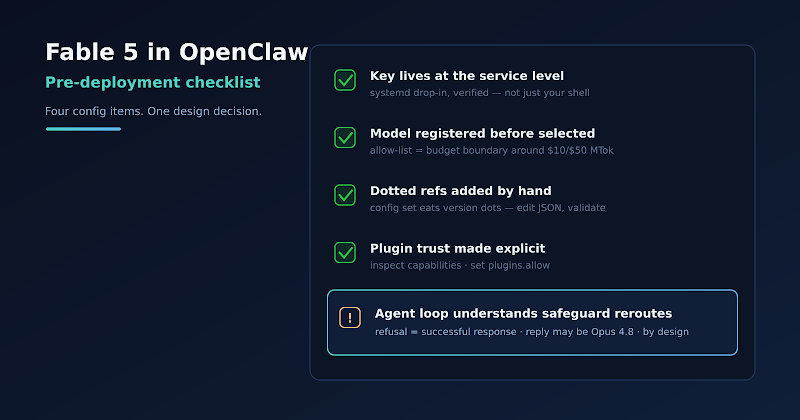
Items one through four are one-time configuration. Item five is a design decision, and the one most worth reviewing before an unattended multi-hour run — which is precisely the workload this model tier exists for.
Full walkthrough with complete transcripts: the companion guide.
