

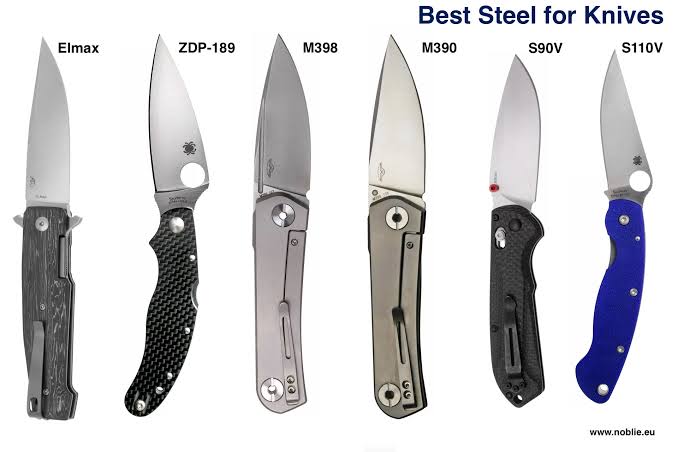
Every knife listing eventually turns into an alphabet soup: S35VN, 14C28N, 20CV, 3V, 8Cr13MoV. The numbers look like they should rank cleanly from worst to best, and plenty of forum arguments treat them that way. They do not rank cleanly, because blade steel is a set of trade-offs rather than a scoreboard. A steel that holds an edge through a week of cardboard will chip if you pry with it. A steel that shrugs off batoning will need touching up more often. Once you understand the shape of those trade-offs, spec sheets stop being intimidating and start being useful.
This guide covers what the four core properties mean in practice, what a hardness number is really telling you, why the heat treatment matters as much as the alloy, and which steels make sense for which jobs.
The Four Properties That Trade Off
Nearly every claim about a blade steel reduces to four measurable characteristics. No steel maximizes all four. Metallurgists spend careers pushing the balance a little further, and even the best modern alloys are still balancing acts.
Edge Retention
How long the blade keeps cutting well before it needs sharpening. This comes mostly from hard carbides – chromium, vanadium, niobium, and tungsten compounds suspended in the steel matrix – plus overall hardness. Vanadium carbides are especially hard and are the reason steels like S30V and MagnaCut outlast simpler alloys on abrasive material. Edge retention is also the property most often overstated in marketing, because it depends heavily on what you are cutting. Cardboard, with its clay and silica fillers, destroys edges far faster than wood or food.
Toughness
Resistance to chipping and cracking under impact or lateral load. Toughness is roughly the opposite of edge retention: the same large carbides that resist abrasion also act as internal stress points where cracks start. This is why a chopper or a survival knife is usually made from a lower-carbide steel run at moderate hardness, while a slicer optimized for edge retention is not something you want to twist in a knot of rope.
Corrosion Resistance
Resistance to rust and staining. This comes from chromium dissolved in the steel matrix – not chromium locked up in carbides, which is a distinction that explains why D2, with around 11 to 12 percent chromium on paper, still spots and patinas. The general rule is that a steel needs roughly 13 percent free chromium to be called stainless, and nitrogen can play a similar role. Corrosion resistance matters more than most buyers expect, because a rusted or pitted edge cuts badly and a stained pivot binds.
Ease of Sharpening
How much effort and what equipment it takes to bring the edge back. High-carbide steels resist your sharpening stones for the same reason they resist the cardboard. With M390 or 20CV, ordinary aluminum oxide stones struggle and diamond or CBN abrasives become close to mandatory. With 420HC or 1095, a cheap ceramic rod restores a working edge in a couple of minutes. If you are new to sharpening, this property deserves far more weight than it usually gets.
What HRC Actually Means
HRC is a hardness figure on the Rockwell C scale. A diamond cone is pressed into the steel under a defined load, and the depth of the resulting indentation produces the number. Higher means harder – more resistant to deformation, generally better at holding a fine edge, generally more prone to chipping.
Pocket and kitchen knives live in a fairly narrow band. Roughly 55 to 58 HRC is soft and forgiving, typical of budget stainless and of large chopping blades. About 58 to 61 HRC is the mainstream sweet spot for folders. Above 62 HRC you are in specialist territory: Japanese kitchen steels, some hard-use slicers, and modern powder alloys designed to tolerate it.
Two cautions. First, one or two points of HRC is not a meaningful difference between two different alloys – a 60 HRC MagnaCut and a 60 HRC 8Cr13MoV are not remotely comparable. Second, manufacturers usually publish a range, and a range wider than two points suggests loose process control.
Heat Treat Beats the Name on the Blade
This is the single most useful thing a new buyer can internalize. The alloy composition sets the ceiling; the heat treatment determines how much of that ceiling the finished blade actually reaches. Austenitizing temperature, soak time, quench speed, cryogenic treatment, and tempering cycles all change the final structure. A badly heat-treated S30V blade can genuinely underperform a well-executed 8Cr13MoV one.
Practical consequences follow. A steel name alone tells you very little about a knife from an unknown brand. Buck’s 420HC is a standing example of a modest alloy that performs well above its reputation because the company’s heat treat is dialed in. Conversely, plenty of cheap knives list impressive steels and deliver soft, poorly hardened blades. Reputation for process control is the thing to research, which is why detailed knife reviews that actually test edges are worth more than a spec table when you are choosing between brands.
Powder Metallurgy in One Paragraph
Conventional steel is cast as an ingot, and as it cools slowly the carbides grow large and clump unevenly. Powder metallurgy instead sprays molten steel into fine droplets that solidify almost instantly, then consolidates that powder under heat and pressure. The result is the same chemistry with much smaller, more evenly distributed carbides. Practically, that means a powder steel can carry a higher alloy load without becoming brittle, takes a cleaner and finer edge, and behaves more consistently. CPM-154 versus 154CM is the clearest comparison: identical composition, noticeably better toughness and grindability in the powder version. Most premium steels sold today – S35VN, MagnaCut, M390, 20CV, 3V – are powder products.
Stainless vs. Carbon
Carbon steels like 1095 contain little or no chromium. They rust readily, develop a grey or blue patina with use, and demand drying and occasional oil. In exchange they are cheap, simple to heat treat well, easy to sharpen, and can be very tough at moderate hardness. They remain the default for fixed blades meant to be beaten on.
Stainless steels resist rust but historically gave up toughness and sharpenability to get there. Modern nitrogen-alloyed and powder stainless steels have closed most of that gap. MagnaCut in particular was designed specifically to break the old trade-off, and it delivers toughness comparable to tool steels while remaining genuinely stainless. If you sweat on your knife, work near salt water, or know you will not maintain it, stainless is the correct default.
A Tour of Common Steels
SteelTierTypical HRCEdge RetentionToughnessCorrosion ResistanceSharpening 420HCBudget stainless56-58LowGoodVery goodVery easy 8Cr13MoVBudget stainless57-59LowGoodGoodVery easy 14C28NValue stainless58-61ModerateVery goodExcellentEasy D2Mid tool steel59-62GoodLowFair (semi-stainless)Moderate 154CM / CPM-154Mid stainless58-61GoodModerateGoodModerate VG-10Mid stainless59-61GoodModerateVery goodModerate S30V / S35VNUpper mid, powder58-61Very goodModerateVery goodHarder CPM MagnaCutPremium, powder60-63Very goodVery goodExcellentModerate M390 / 20CVPremium, powder60-62ExcellentLow to moderateExcellentHard 1095Carbon55-58LowVery goodPoorVery easy CPM 3VPremium tool steel58-61GoodOutstandingFairModerate A few notes the table cannot carry. 8Cr13MoV and 420HC are perfectly serviceable for light duty and are the right place to learn sharpening. 14C28N is the standout value pick: a Sandvik nitrogen-alloyed stainless that takes a very keen edge and resists rust better than steels costing three times as much. D2 is the odd one out, an old die steel with coarse carbides that gives real edge retention but chips under lateral stress and is not truly stainless.
Among premium options, S35VN is the refined successor to S30V, with niobium added for slightly better toughness and easier grinding. M390 and 20CV are chemically near-identical high-vanadium stainless steels that hold an edge a long time and punish anyone without diamond stones. MagnaCut is the current benchmark for balance rather than for any single extreme.
Picking a Steel for the Job
- Office and urban EDC. You are opening boxes, cutting tape, and trimming zip ties. Corrosion resistance and fine slicing matter; impact toughness does not. 14C28N, CPM-154, S35VN, and MagnaCut all fit. M390 or 20CV works if you own diamond stones or do not mind long sharpening sessions.
- Wet, humid, or coastal use. Rust is the failure mode, not dullness. Prioritize stainless with high free chromium or nitrogen content: 14C28N, MagnaCut, or LC200N if you can find it. Avoid D2, 1095, and 3V unless you are diligent about drying and oiling.
- Bushcraft and hard fixed-blade use. Batoning, carving, and prying reward toughness and easy field sharpening over carbide content. CPM 3V is the premium answer; 1095, 80CrV2, and similar simple carbon steels are the affordable and entirely adequate one. Skip high-vanadium stainless here.
- Kitchen. Thin geometry and a keen edge matter more than wear resistance, and food acids plus a wet sink argue for stainless. VG-10, AEB-L, 14C28N, and MagnaCut are all strong picks. Avoid brittle, very hard steels if anyone in the house cuts on glass or ceramic.
What the Spec Sheet Leaves Out
Blade geometry decides more about cutting performance than alloy does. A thin blade with a well-executed grind in mediocre steel will out-cut a thick, obtusely ground blade in a premium alloy, every time. Edge angle, primary grind height, and blade stock thickness never appear in the steel argument but dominate how a knife feels in use. Heat treat, as covered above, is the other invisible variable.
The practical advice for a first few good knives is unglamorous: buy from makers with a track record for consistent heat treatment, start with a mid-tier steel you can actually sharpen, learn what dull feels like in your own hands, and only then decide whether you want to pay for the last increment of edge retention. Spec sheets are a starting filter, not a verdict. If you want to go deeper on specific models and how they hold up in real use, resources like knifeknowledge.com are a better guide than a composition chart.
