

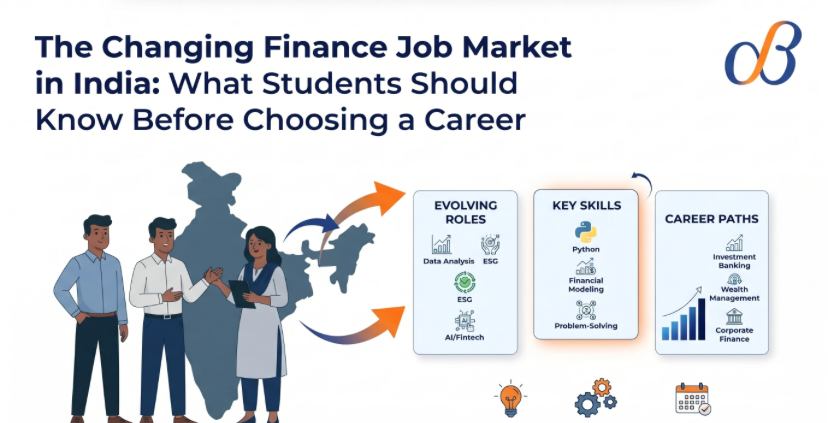
Your finance career doesn’t have to begin and end with investment banking or accounting. From financial analytics and fintech to risk management and global finance teams, the opportunities available to students are expanding. But so are employers’ expectations.
A degree can give you the foundation. A professional qualification can deepen your knowledge. Yet, in a job market increasingly shaped by technology, employers also want to know what you can actually do with that knowledge.
For students planning a career in finance, this changes the game. Choosing the right path now means understanding the roles available, the skills employers value, and how to prepare for the work itself.
What Is Changing in India’s Finance Job Market?
Three shifts are reshaping finance careers: technology is becoming part of everyday work, finance teams are contributing more to business decisions, and opportunities are emerging beyond traditional employers.
Finance is becoming more technology-driven
Artificial intelligence (AI), automation and data analytics are changing how finance professionals collect information, prepare reports and analyse financial performance. Digital payments and other financial technologies are also creating new ways to deliver financial services.
The change is already visible. According to ACCA’s Global Talent Trends 2026: India report, 57% of surveyed finance professionals in India were using AI technologies in their current roles.
Finance is moving beyond routine accounting
Finance teams increasingly contribute to budgeting, forecasting, risk analysis and business planning. Instead of simply reporting what happened, professionals are expected to help explain why it happened and what a business should do next.
That makes analytical thinking, financial modelling and the ability to communicate insights increasingly valuable.
New career paths are opening up
Fintech companies, wealth management firms, analytics teams and Global Capability Centres (GCCs) offer opportunities beyond the traditional routes into banking and accounting. Understanding these options can help students find a role that matches their interests rather than following the most familiar career path.
Which Finance Careers Can Students Consider?
Before choosing a qualification, understand the work you want to do. Here are some finance career options worth exploring.
| Career path | What you’ll do | Useful skills |
| Financial analyst | Analyse financial data and company performance | Excel, financial analysis |
| Financial Planning and Analysis (FP&A) | Prepare budgets, forecasts and business plans | Modelling, Excel, analytics |
| Equity research | Study companies, industries and investment opportunities | Valuation, research, financial statements |
| Risk management | Identify and assess financial risks | Statistics, analytical thinking |
| Wealth management | Help clients plan and manage their investments | Market knowledge, communication |
| Corporate finance | Support funding, financial planning and business decisions | Financial modelling, analysis |
| Finance analytics | Use data to improve financial decisions | Excel, SQL, Python, data visualisation |
| Fintech | Work at the intersection of finance and technology | Finance knowledge, digital tools |
| GCC finance | Support global finance functions such as reporting, planning and risk | Finance, analytics, technology |
These roles aren’t interchangeable. Equity research may suit someone who enjoys studying companies and markets, while FP&A may appeal to someone interested in how businesses plan spending and measure performance. Finance analytics may be a better fit for someone who enjoys working with both numbers and data tools.
The point isn’t to select a role for life. It’s to understand the options well enough to make your next move deliberately.
Why Skills Are Becoming as Important as Qualifications
A qualification helps you learn concepts systematically. But understanding a concept and applying it to a real business problem are two different things.
Imagine knowing how to calculate a company’s profitability. Can you also explain why its margins have fallen, identify the information needed to investigate the problem and communicate your findings clearly? That’s where finance practical skills make a difference.
Students preparing for finance jobs should build three groups of skills.
1. Technical finance skills: Learn to read financial statements, understand accounting fundamentals, analyse company performance and work with concepts such as valuation, financial modelling and risk.
2. Data and technology skills: Start with Excel and data interpretation. Depending on your chosen role, add Power BI, SQL or Python. Learn to use AI tools responsibly, verify their outputs and protect confidential information.
3. Human skills: Communication, critical thinking, problem-solving, collaboration and adaptability matter because financial insights are useful only when people can interpret them and act on them.
You don’t need to master everything at once. Start with the skills most relevant to your target role, then expand as your interests and experience develop.
How Is AI Changing Finance Careers?
AI is not simply a story about jobs disappearing. It’s also a story about how work is changing.
Tasks such as routine data processing, basic reporting, information gathering and repetitive calculations can increasingly be automated. This can reduce manual work, but it also raises the bar for what professionals contribute beyond completing those tasks.
Consider financial analysis. An AI tool may help organise data or produce an initial summary. A finance professional still needs to check the numbers, assess whether the conclusion makes sense, understand the business context and explain the implications.
That combination of technology and judgement is important. ACCA’s 2026 India research highlights both the adoption of AI and the concerns professionals have about its impact on their roles.
The shift is also visible in hiring. A July 2026 report by Business Standard, citing foundit Insights Tracker data, reported that 64% of new GCC roles created in 2026 required AI, data science or intelligent-automation skills.
This doesn’t mean every finance professional needs to become a programmer or AI engineer. It means you should understand which tools are relevant to your work and learn how to use them effectively.
The Rise of Finance Opportunities in India’s GCCs
Global Capability Centres, or GCCs, are teams established by multinational companies in India to support their global operations. Many now contribute to more than routine back-office work, including analytics, risk, business planning and finance transformation.
For finance students, this creates another avenue to explore beyond banks, accounting firms and domestic financial companies.
Potential roles include:
- FP&A and business finance
- Financial reporting and controllership
- Risk analysis
- Financial analytics
- Finance transformation and automation
GCC opportunities are evolving alongside demand for technology and analytical skills. As the foundit data reported by Business Standard indicates, AI and data capabilities are becoming increasingly relevant across new GCC roles.
When researching jobs, look beyond the company name. Read the job description, identify the skills it requires and understand whether the role involves reporting, analysis, planning or decision support.
Should You Choose a Degree, Certification or Practical Skills?
These aren’t competing choices. Each serves a different purpose.
- A degree builds academic foundations and may meet eligibility requirements for graduate roles.
- A professional qualification or certification offers structured, specialised learning aligned with particular career interests.
- Practical skills demonstrate your ability to apply what you’ve learned.
- Experience helps you understand workplace expectations and build evidence of your capabilities.
The right combination depends on your goals. Someone interested in investment research may need a different learning path from someone targeting finance analytics or risk management.
Before enrolling in a course, understand the role you’re aiming for, check what employers expect and assess what you already know. This helps you avoid collecting qualifications without building the skills needed to use them.
How Students Can Prepare for a Finance Career
You don’t need to wait until graduation to start becoming job-ready. Here’s a practical plan.
Step 1: Explore different roles. Read job descriptions, attend industry sessions and speak to professionals. Find out what people actually do in the roles that interest you.
Step 2: Build finance fundamentals. Start with accounting, financial statements, economics, markets and corporate finance. These concepts provide a foundation for several finance careers.
Step 3: Develop relevant technical skills. Practise Excel, financial modelling, valuation or data analysis based on your target role. Learn SQL, Python or Power BI where they are useful.
Step 4: Create proof of your skills. Analyse a listed company’s financial statements, build a basic financial model or prepare a research report. For analytics roles, try a project that turns raw data into useful insights.
Step 5: Gain practical exposure. Apply for internships, participate in case competitions, complete student projects and attend industry events. These experiences help you connect classroom learning with workplace problems.
Step 6: Keep learning. Tools, business needs and job requirements change. Review your skills regularly and update them based on the direction you want your career to take.
How to Choose the Right Finance Career Path
Your interests can offer a useful starting point.
- Enjoy studying markets and companies? Explore equity research and investment roles.
- Prefer planning, budgets and business performance? Consider FP&A or corporate finance.
- Like statistics, uncertainty and problem-solving? Look into risk management.
- Enjoy working with clients and investments? Explore wealth management.
- Interested in technology and data? Consider fintech or finance analytics.
- Curious about how multinational businesses operate? Research finance roles in GCCs.
You don’t need to have your entire career figured out before graduation. Your first role can help you discover what you enjoy, which skills you want to develop and where you want to specialise.
Common Mistakes to Avoid When Planning a Finance Career
A few common mistakes can make the transition from college to work harder than it needs to be.
- Choosing a qualification before understanding the role: Work backwards from your career goals.
- Focusing only on marks and exams: Academic performance matters, but practical application matters too.
- Ignoring technical skills: Build relevant tools and project experience alongside theoretical knowledge.
- Waiting until graduation to seek experience: Start with small projects, internships or competitions.
- Treating AI as either a threat or a solution to everything: Learn where it helps, where it falls short and when human judgement is essential.
- Applying for every finance job: Tailor your preparation to the responsibilities and skills each role requires.
What Should Students Focus on Over the Next Few Years?
Rather than trying to predict which finance job will be the most popular in five years, focus on building a foundation that can adapt to change.
Combine strong finance fundamentals with practical skills, technology awareness, communication and relevant experience. You don’t need to chase every new tool or trend. You need to understand your chosen field and keep learning what helps you do the work better.
That approach can make you more prepared for new roles, changing responsibilities and opportunities you may not have considered yet.
Choose a Career Path, Not Just a Qualification
India’s finance job market is broadening, and technology is changing how many roles operate. For students, the opportunity lies in understanding the options, identifying their interests and building skills that employers can see in action.
Start by exploring different careers. Strengthen your financial knowledge, practise relevant tools, work on projects and seek practical exposure. Then choose qualifications that support your direction.
The goal isn’t to predict the future of finance perfectly. It’s to become the kind of professional who can adapt as it changes.
Frequently Asked Questions
1. Is finance still a good career option in India?
Yes, finance offers opportunities across banking, corporate finance, investment research, risk, wealth management, fintech and GCCs. However, the skills required are evolving, making practical experience, analytical ability and technology awareness increasingly useful.
2. What skills are important for finance jobs?
Financial analysis, accounting fundamentals, Excel, financial modelling and data interpretation are useful starting points. Depending on the role, SQL, Python or Power BI may also help. Communication and critical thinking are important across many finance careers.
3. Will AI replace finance jobs?
AI can automate some routine tasks, but finance professionals are still needed to validate information, interpret results, understand business context and make informed decisions. The impact will vary by role, so learning to use relevant tools responsibly is a practical step.
4. Should finance students learn technology and AI?
Yes, to a level relevant to their chosen career. Students don’t need to become AI engineers, but understanding data tools, AI applications and their limitations can help them work more effectively.
