

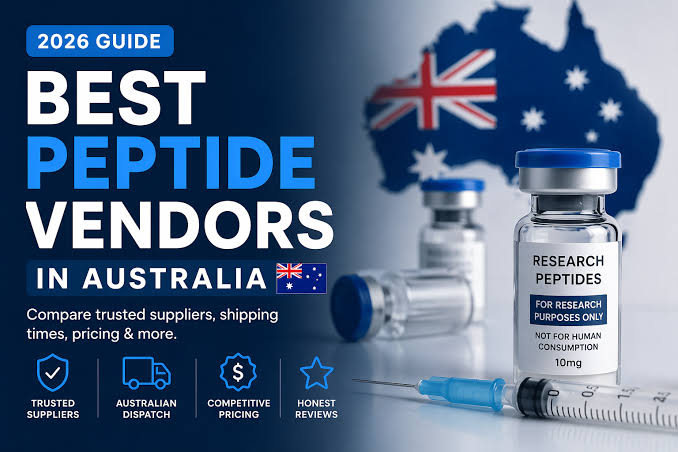
Every year a new cohort of biochemistry, pharmacology and biomedical science students walks into a laboratory and meets a vocabulary that nobody taught them in lectures. Lyophilised. Reconstitution. HPLC trace. Certificate of Analysis. Bacteriostatic water. The words arrive faster than the explanations. This guide is written for that student, and for the early-career researcher who has just been handed responsibility for ordering consumables. It covers the language of peptide research, the lab habits that keep work reproducible, and how research compounds are sourced responsibly within Australia.
One point needs to be stated at the outset, because it frames everything else. The research peptides discussed here are sold strictly for laboratory and research use only. They are not for human or animal consumption, they are not approved medicines, and reputable Australian suppliers require buyers to confirm they are over 18 and qualified researchers before an order is accepted. A student working under supervision in an institutional lab fits that description; a curious person at home does not.
Peptides, defined without the jargon
A peptide is a short chain of amino acids joined by peptide bonds. Where a protein might run to hundreds of residues folded into a complex structure, a peptide is typically between two and around fifty residues long. That modest size is precisely why laboratories find peptides so useful as research tools: they are small enough to synthesise chemically with high precision, stable enough to store and ship, and specific enough to interact with a defined biological target in an assay.
Most research peptides are produced by solid-phase peptide synthesis, a method in which amino acids are added one at a time to a growing chain anchored to a resin. The finished chain is cleaved from the resin, purified, and usually freeze-dried into a powder. Understanding this origin helps a student read everything that follows, because the main quality questions in peptide research, purity, identity and stability, all trace back to how the molecule was made and handled afterwards.
The vocabulary you will actually hear
A short glossary saves a great deal of embarrassment. These are the terms that come up most often when research peptides are discussed, ordered and handled in Australian laboratories.
- Lyophilised: freeze-dried. Water is removed under vacuum from a frozen solution, leaving a dry powder that is far more stable than a liquid. Most research peptides arrive in this form, sealed in a small glass vial.
- Reconstitution: the process of dissolving a lyophilised compound back into a liquid for use in an experiment. In a research setting this is done at the bench, with the solvent chosen to suit the assay.
- Bacteriostatic water: sterile water containing a small amount of a preservative that inhibits bacterial growth. It is a common laboratory solvent and appears in supplier catalogues under laboratory supplies.
- HPLC: high-performance liquid chromatography. A technique that separates the components of a sample as they pass through a column, producing a chromatogram in which the main peak represents the target compound and smaller peaks represent impurities.
- Mass spectrometry: a method that measures the mass-to-charge ratio of molecules, used to confirm that the compound in the vial has the molecular weight expected for the intended sequence.
- Certificate of Analysis (COA): a document, usually batch-specific, that records the analytical results for a product, typically including purity by HPLC and identity by mass spectrometry.
- Batch or lot number: the identifier printed on a vial that links it to a specific production run and its documentation.
Reading a Certificate of Analysis like a supervisor
The COA is the single most important piece of paper in peptide research, and students are rarely taught how to read one. When a supplier states a purity figure, for example a claim of 99 percent or higher verified by HPLC, the COA is where that figure is supposed to be substantiated. A student should look for a few things. First, does the document name the compound and a batch number that matches the vial in hand? A generic certificate with no batch reference is far less useful. Second, does it describe the method used, including the HPLC conditions, so that the result could in principle be reproduced? Third, is there an identity confirmation, usually a mass spectrometry result showing an observed mass close to the theoretical mass of the sequence?
Supervisors also pay attention to who performed the analysis. A certificate issued by an independent third-party laboratory carries more weight than one produced in-house, because it separates the party selling the compound from the party vouching for it. Australian suppliers who take documentation seriously will usually state that every batch is sent for third-party analysis by HPLC and, or, mass spectrometry, and will make COAs available on request or publish them on a batch documentation page. For a student, the habit of requesting and filing the COA alongside the lab notebook entry for an experiment is one of the earliest marks of good practice.
Everyday lab habits that protect your results
Peptides are sensitive molecules, and a surprising number of failed experiments trace back to storage and handling rather than to the science. Several habits are worth building early.
Store lyophilised peptides frozen. The standard guidance from suppliers is -20°C for the dry powder, which slows the chemical degradation pathways that can alter a sequence over time. Once a compound has been reconstituted, it should be kept refrigerated and used within a limited window, commonly stated as four weeks, after which the solution should be treated as unreliable for research purposes. Label every vial with the date it was opened or reconstituted, because memory is not a laboratory record.
Avoid repeated warming and cooling of the same vial. Each time a frozen vial is brought to room temperature and returned to the freezer, condensation can form inside and moisture is one of the main enemies of a lyophilised powder. Many labs aliquot a reconstituted solution into smaller tubes so that only the portion needed for a given experiment is ever thawed.
Keep records that link the compound to the data. A result in a notebook should always be traceable to a supplier, a batch number and a COA, because the first question any reviewer asks about an unexpected result is whether the reagent was what it claimed to be.
Sourcing responsibly: how Australian supply works
Early-career researchers are often surprised to learn that ordering research compounds is a skill in its own right. In Australia, therapeutic goods are regulated by the Therapeutic Goods Administration, and research-use-only compounds are not approved medicines. They are supplied to laboratories on the explicit basis that they will be used in research, not administered to people or animals. A responsible supplier will make this framing prominent, will require an acknowledgement that the buyer is over 18 and a qualified researcher, and will not describe its products in the language of treatments or supplements.
Domestic supply has become the preferred route for many Australian labs, largely because it removes the uncertainty that comes with international parcels of temperature-sensitive material. When a student in a university laboratory searches for peptides Australia with a view to placing a departmental order, the questions worth asking a supplier are practical ones: where is stock dispatched from, how quickly does an order ship, is express delivery available Australia-wide, and can a COA be supplied for the specific batch being purchased? Suppliers dispatching from capital cities such as Melbourne and Sydney, with same-day dispatch for orders placed before a published cut-off, can usually get a vial to a metropolitan lab the following day, which matters when a freezer slot and a cold pack are waiting at the other end.
Evaluating a supplier as a first-time purchaser
A simple way to assess an unfamiliar Australian supplier is to work through a short checklist before committing a departmental budget.
- Confirm the supplier states clearly that products are for laboratory and research use only and requires age and researcher confirmation at checkout.
- Check that purity claims are tied to a method, such as HPLC, and that third-party testing is described rather than merely implied.
- Ask for a COA for the batch you intend to buy, and compare the batch number to what arrives.
- Look for published storage guidance consistent with standard practice: frozen powder, refrigerated solutions with a defined use-by window.
- Note the dispatch locations, shipping method and cut-off times so that delivery can be timed to when someone is in the lab to receive it.
- Verify that the business is Australian-owned and operated and serves Australian customers, which simplifies communication if anything goes wrong.
Suppliers such as Peak Haven, which positions itself around third-party verified purity, batch documentation and express dispatch from Melbourne and Sydney, illustrate the kind of transparency that a student should expect as standard rather than treat as a bonus.
Practical wrap-up
For a student or early-career researcher, the path to competence with research peptides is short and concrete. Learn the core vocabulary so that lab meetings make sense. Read every COA, check the batch number against the vial, and file it with your notebook. Store powders at -20°C, keep reconstituted solutions refrigerated and dated, and never let a vial outlive its documented window. When sourcing, favour Australian suppliers who publish their research-use-only terms, verify purity through independent HPLC and mass spectrometry, dispatch quickly from local warehouses and answer questions about documentation without hesitation. Those habits, formed early, will outlast any single project and mark you as a researcher whose results can be trusted.
