

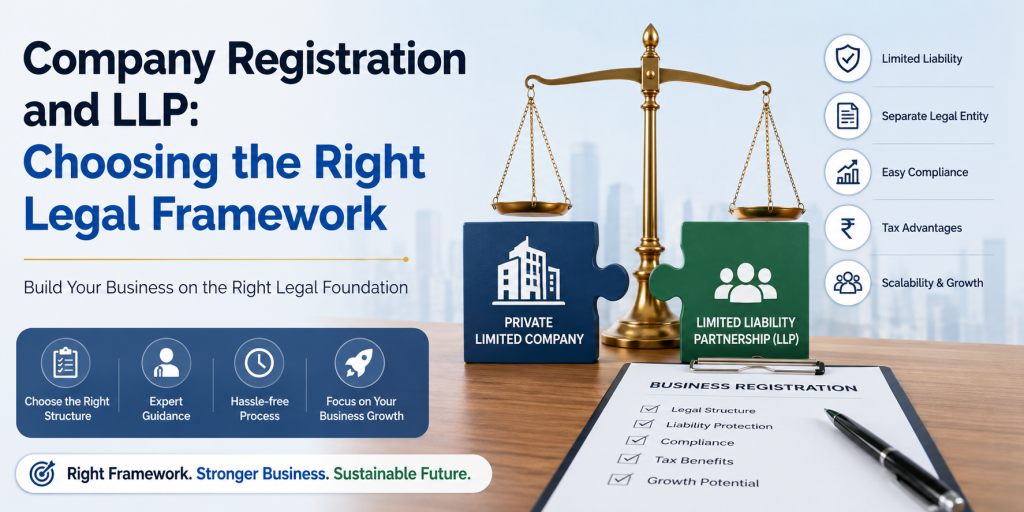
Most founders don’t struggle with company registration itself, the SPICe+ and FiLLiP forms are well documented online. What they actually struggle with is choosing the right business structure before registering. Choose a Private Limited Company when an LLP would have been enough, and you’re left with unnecessary board meetings, stricter compliance, and mandatory audits. Choose an LLP when your business needs equity fundraising, and you may face a costly conversion to a Private Limited Company within months of incorporation.
This decision matters even more in 2026, with the MCA V3 portal, updated stamp duty structures, and recent LLP amendments reshaping the incorporation and compliance landscape. Many first-time founders assume that limited liability makes LLPs and Private Limited Companies interchangeable, they’re not. The right structure depends on your funding plans, ownership model, long-term growth strategy, and the level of compliance you’re prepared to manage each year.
Company Registration vs LLP: The Core Legal Difference
A Private Limited Company is incorporated under the Companies Act, 2013, and can issue equity shares to raise capital, while an LLP is incorporated under the LLP Act, 2008, and operates through partner contributions without the ability to issue shares. Both are separate legal entities with limited liability protection, but that’s largely where the similarity ends.
Did You Know? A Private Limited Company Registration can convert into an LLP, and an LLP can convert into a Private Limited Company under Section 366 of the Companies Act – but both conversions require fresh filings, professional fees, and typically 4–6 weeks of processing time.
Decision Framework: Which Structure Fits Your Business?
If you’re still unsure which structure suits your business, answer the following questions. Your responses will help identify whether a Private Limited Company or an LLP is likely to be the better fit for your goals.
| Question | Best option |
| Do you plan to raise venture capital or angel investment? | Private Limited Company |
| Do you plan to offer ESOPs to employees? | Private Limited Company |
| Is your business a professional service firm or consultancy? | LLP |
| Do you want to minimise annual compliance and audit costs? | LLP |
| Do you need easy ownership transfer for future investors? | Private Limited Company |
Full Comparison: Company vs LLP
Once you’ve narrowed down your options, compare the two business structures across key legal, operational, and compliance factors to understand how they differ in practice.
| Feature | Private Limited Company | LLP |
| Governing Law | Companies Act, 2013 | LLP Act, 2008 |
| Incorporation Form | SPICe+ | FiLLiP |
| Minimum Members | 2 shareholders, 2 directors | 2 partners, 2 designated partners |
| Liability Protection | Limited to unpaid share value | Limited to agreed contribution |
| Minimum Capital | No minimum, but authorised capital must be stated | None mandatory under the LLP Act, 2008 |
| Equity Fundraising | Can issue shares to investors and grant ESOPs | Cannot issue equity shares |
| Compliance Burden | Higher – board meetings, statutory audit, AOC-4, MGT-7 | Lower – Form 11, Form 8; audit optional until turnover exceeds ₹40 lakh or capital exceeds ₹25 lakh |
| Ownership Transfer | Easy via share transfer | Requires LLP Agreement amendment |
| Resident Director/Partner | At least one resident director required | At least one designated partner must be resident in India (120+ days per financial year) |
| Government Incorporation Fee | Nil for authorised capital up to ₹15 lakh | ₹500–₹5,000 based on contribution slab |
| Best Suited For | Startups planning to scale, raise funding, or issue ESOPs | Professional firms, consultancies, small partnerships |
Registration Process
Although the incorporation process is largely online for both entities, the forms, post-registration compliances, and documentation requirements differ. Here’s a side-by-side comparison of the registration process for a Private Limited Company and an LLP.
| Stage | Private Limited Company (SPICe+) | Limited Liability Partnership (FiLLiP) |
| 1. Digital Signature Certificate (DSC) | Obtain DSC for all proposed directors. | Obtain DSC for all designated partners. |
| 2. Name Reservation | Reserve the company name through SPICe+ Part A (or directly in SPICe+ Part B, where applicable). | Reserve the LLP name through RUN-LLP or as part of the FiLLiP application. |
| 3. Incorporation Filing | File SPICe+ Part B along with AGILE-PRO-S and other linked forms. | File the FiLLiP form with the required incorporation documents. |
| 4. Certificate of Incorporation | Receive the Certificate of Incorporation (COI) along with PAN, TAN, and CIN. | Receive the Certificate of Incorporation, LLPIN, PAN, and TAN. |
| 5. Post-Incorporation Compliance | File INC-20A (Declaration for Commencement of Business) within 180 days of incorporation (applicable only where the company has share capital). | Execute the LLP Agreement and file Form 3 within 30 days of incorporation. |
| Typical Registration Timeline | 7–10 working days | 7–10 working days |
Cost Comparison for 2026
Company Registration: Private limited company registration costs Rs 7,000-25,000 all-inclusive for a standard two-director company with authorised capital between Rs 1-10 lakh in 2026, with SPICe+ filing free for capital up to Rs 15 lakh and PAN/TAN auto-allotted at no cost.
LLP Registration: LLP registration fees typically range between ₹5,000 and ₹15,000, covering MCA government fees, DSC charges, state stamp duty on the LLP Agreement, and professional charges.
Important Cost Insight: In both structures, stamp duty – not the government incorporation fee – is usually the largest and most variable cost, since it depends entirely on the state where you register and your authorised capital or contribution amount.
Documents Required (Common to Both)
- PAN and Aadhaar of all directors/partners
- Passport-size photographs
- Proof of registered office (utility bill + NOC or rent agreement)
- Digital Signature Certificates
- Identity and address proof of subscribers/partners
Compliance Checklist: Company vs LLP
Private Limited Company:
- Minimum 4 board meetings a year
- Annual filing of Form AOC-4 and MGT-7
- Statutory audit compulsory, regardless of turnover
- INC-20A within 180 days of incorporation
LLP:
- Form 11 (Annual Return) by 30th May every year
- Form 8 (Statement of Accounts and Solvency) by 30th October every year
- Audit required only when turnover exceeds ₹40 lakh or contribution exceeds ₹25 lakh
- LLP Agreement filed within 30 days of incorporation
Common Mistakes Founders Make While Choosing
- Picking a company structure purely for credibility without a genuine fundraising plan, resulting in unnecessary board meetings and audit costs.
- Registering an LLP while planning to raise venture capital – investors typically decline to fund LLPs since they cannot issue equity shares.
- Ignoring conversion costs – assuming a structure can be changed later at no real expense, when conversion involves fresh filings and professional fees.
- Underestimating state-wise stamp duty differences, leading to budgeting surprises during incorporation.
- Not accounting for compliance bandwidth – a solo founder juggling operations may struggle with a company’s mandatory board meeting and audit requirements.
- Overlooking the residency requirement for at least one director/designated partner, which delays incorporation for founder teams based entirely outside India.
Case Study
Two co-founders building a legal-tech SaaS product initially registered an LLP to keep early costs low. Within a year, a seed investor offered funding – contingent on receiving equity shares and a board seat, neither of which an LLP could provide. The founders had to convert the LLP into a Private Limited Company under Section 366 of the Companies Act, which took nearly two months and delayed fund disbursement. Had they mapped their 2–3 year funding trajectory at the outset, they could have registered directly as a Private Limited Company and avoided the conversion entirely.
Conclusion
Choosing between company registration and LLP isn’t about which structure is better – it’s about which one matches your business’s funding plans, ownership goals, and compliance appetite. A Private Limited Company suits founders building toward equity fundraising, ESOPs, and scale, while an LLP suits professional service businesses that prioritise lower compliance and operational flexibility. The cost of getting this decision wrong isn’t just financial – it’s the time lost to conversions, missed funding windows, and compliance backlogs. Speak to a professional before you file, not after.
Why Choose Zolvit
- Expert lawyers, CAs, and Company Secretaries to assess your structure before you register
- Fast, accurate filing on the MCA V3 portal to avoid rejection delays
- Affordable, transparent pricing with no hidden costs
- End-to-end compliance support for both companies and LLPs
- Dedicated support from incorporation through annual filings
FAQ
1. Can I switch from an LLP to a Private Limited Company later?
YES. An LLP can be converted into a Private Limited Company under Section 366 of the Companies Act, 2013. The process requires fresh incorporation filings and typically takes 4–6 weeks with professional assistance.
2. Should a startup planning to raise venture capital register as an LLP?
NO. LLPs cannot issue equity shares, which most institutional investors require. A Private Limited Company is the preferred structure for startups planning to raise external funding.
3. Is a minimum capital required for either structure?
NO. Neither a company nor an LLP requires a minimum paid-up or contribution amount. Companies must state an authorised capital figure, while LLPs simply declare a contribution value.
4. Can foreign nationals be part of either structure?
YES. Foreign nationals can be directors in a company or partners in an LLP, provided at least one resident director or designated partner is based in India as required by law.
5. Shall a professional services firm choose an LLP over a company?
YES, typically. Professional firms and consultancies generally benefit more from an LLP’s lower compliance burden, since they rarely need equity fundraising or ESOP structures.
